
How to Play Online Casino Games: A Beginner’s Guide
Online casino lobbies can feel overwhelming at first. A new player may see hundreds of slots, several versions of blackjack and roulette, live dealer rooms, jackpots, and unfamiliar terms such as RTP, volatility, wagering requirements, and RNG.
Learning how to play online casino games does not require mastering everything at once. A sensible beginner starts by checking whether online gambling is legal locally, choosing a properly licensed operator, learning one game, and setting a fixed entertainment budget.
The aim is not to find a guaranteed winning system-none exists – but to understand the rules, costs, and risks before using real money. This beginner’s guide explains the journey from registration to withdrawal.
It also shows how to compare games, use demo mode, understand stakes, evaluate bonuses, and recognize when it is time to stop. It is important to remember that convenient access does not reduce the financial risks associated with casino gambling.
1. Check Local Rules and Casino Licensing
Online gambling laws and minimum-age requirements vary by jurisdiction. Confirm that the operator may legally serve your location and that you meet the applicable age limit.
Do not trust a licence logo by itself. Search for the operator or domain in the regulator’s official register. The UK Gambling Commission, for example, provides a public register for checking licensed gambling businesses.
Review withdrawal terms, customer support, game providers, privacy information, and responsible gambling tools before registering. Clear policies are generally more valuable than an unusually large promotional offer.
2. Create and Verify Your Account
Registration usually requires your name, date of birth, address, contact details, and a password. Enter accurate information because inconsistencies can delay verification or payments.
Licensed operators may perform age and identity checks. In Great Britain, online gambling businesses must verify both before allowing a customer to gamble. Depending on local rules, you may need an identity document or proof of address.
Use a unique password and enable two-factor authentication when available. Never send login codes or personal documents through unofficial accounts or social-media messages.
3. Choose One Beginner-Friendly Game
Slots are mechanically simple: select a stake, press spin, and check the paytable for winning combinations. Blackjack involves decisions such as hit, stand, double, and split, while roulette uses bets on numbers, colors, and groups.
Baccarat usually focuses on Player, Banker, or Tie wagers. Live dealer games stream real tables, but bets are still placed through a digital interface.
Choose one category and read its help screen before playing. Pay attention to minimum stakes, payouts, side bets, special rules, and decision timers.
4. Practise Before Betting Real Money
Demo mode helps you learn buttons, paylines, paytables, and game flow without risking cash. It is useful for deciding whether a title is too fast, complicated, or expensive for your preferred budget.
Free play does not reproduce the emotions of losing real money, and its results do not predict future outcomes. Treat it as a lesson in mechanics rather than proof that a game will be profitable.
When switching to real-money play, begin with the smallest practical stake. Do not increase a wager simply because previous rounds lost.
5. Understand RNG, RTP, and Volatility
Automated games generally use a random number generator. UK technical standards require results to be acceptably random, while testing laboratories examine RNG systems for predictability and bias.
Return to Player, or RTP, describes the average proportion of wagers a game is designed to return as prizes over extensive play. It does not promise a specific result during one session.
Volatility describes how prizes may be distributed. Lower-volatility games tend to provide smaller, more frequent wins, while higher-volatility games may create longer losing stretches before producing a larger prize.
6. Set a Bankroll and Session Limit
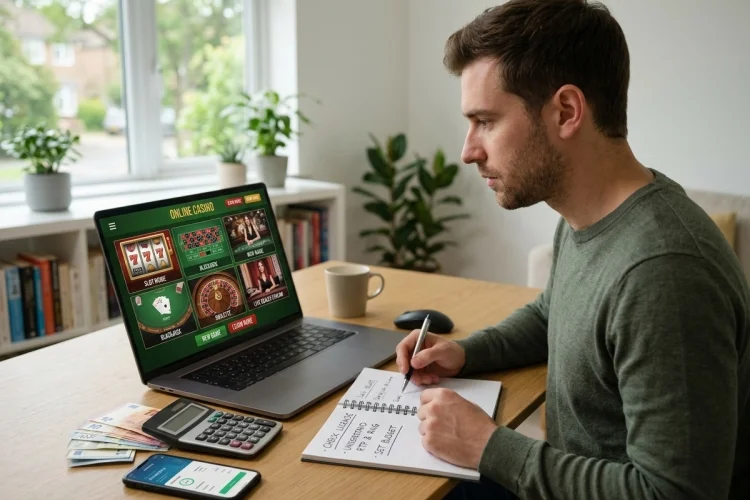
Choose only money you can afford to lose without affecting bills, food, savings, or debt payments. Divide the budget into small sessions rather than depositing everything at once.
Set the stake, time limit, and stopping point before the first wager. A $30 entertainment budget, for example, could become three $10 sessions instead of one unrestricted deposit.
Never chase losses by depositing again or doubling bets. GambleAware recommends setting a spending limit in advance and warns against gambling to make money or spending more than you can afford.
7. Read Bonuses and Withdrawal Terms
Welcome offers may include matched deposits, free spins, or cashback. Check the wagering requirement, eligible games, maximum bet, expiry date, and withdrawal cap before accepting.
A $50 bonus with 30x wagering on the bonus requires $1,500 in qualifying bets. The advertised amount is therefore not the same as immediately withdrawable cash.
Also check minimum withdrawals, fees, processing estimates, and permitted payment methods. Completing verification early can reduce avoidable delays.
Learning how to play online casino games begins with preparation, not betting. Check local legality, verify the licence, secure your account, study one game, and practise in demo mode. Understand that RNG outcomes are unpredictable and RTP describes long-term performance rather than tonight’s result.
The most important beginner skill is controlling money and time. Use a fixed entertainment budget, avoid chasing losses, and read every bonus and withdrawal condition. Keep a record of deposits and withdrawals.
Start by opening a game’s information screen and learning its rules without depositing. Only consider real-money play when the process, costs, and personal limits are completely clear.