
Author: Larissa Cardoso

Online Slots

How Slot Themes Influence the Player Experience Beyond the Reels

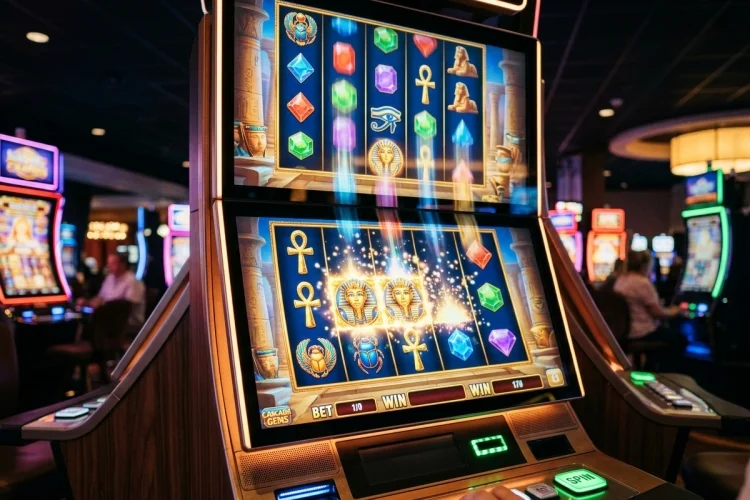
Two slot games can use similar reels, paylines, and bonus mechanics yet feel completely different. One might place you inside a mysterious Egyptian temple, while another uses futuristic robots, cheerful animals, or characters from a familiar television series.

That difference shows How Slot Themes Influence the Player Experience long before the mathematics becomes noticeable. Themes shape first impressions, sound, animation, storytelling, and even how bonus features are presented.

They cannot improve the underlying odds by themselves, but they can strongly influence whether a game feels relaxing, dramatic, playful, nostalgic, or intense.

Themes Create the First Impression

Before someone checks RTP, volatility, or a paytable, they usually see the artwork.

Colour, characters, backgrounds, reel symbols, and animation immediately communicate what kind of experiance the developer wants to create.

A mythology-themed slot may use temples, gods, flames, and dramatic gold effects. A candy-themed game might choose bright colours, playful animations, and lighter music.

Neither approach changes the probability of a random result simply because the artwork looks different.

However, presentation can determine whether someone even opens the game in the first place.

That makes theme an important discovery tool in crowded casino lobbies. When hundreds or thousands of slots are available, a clear visual identity helps one title stand apart from another.

Storytelling Can Give Bonus Features More Meaning

Modern slots increasingly use themes to connect different features.

Free spins do not have to appear as a generic second screen. Developers can present them as entering a hidden temple, escaping a villain, opening a treasure room, or completing part of an adventure.

This creates a simple form of storytelling.

Playtech describes its casino development approach as combining advanced graphics, storylines, mechanics, branded content, and interactive bonus rounds to create more immersive experiences.

That does not mean every slot contains a complicated narrative.

Often, the story is extremely light. A character may simply move to another location when a bonus begins.

Even that small change can make a feature feel connected to the overall game rather than appearing as an unrelated mathematical event.

Music Changes the Emotional Tone

Sound is one of the easiest slot-design elements to underestimate.

Imagine an adventure-themed game without music, symbol sounds, or bonus audio. The mathematics would remain the same, but the presentation would feel dramatically flatter.

Research supports the idea that sound affects the gambling experience. A study involving 96 participants found that slot-machine sounds influenced arousal and player preference, with most participants preferring play accompanied by winning sounds.

The researchers also found that sound affected participants’ estimates of how frequently they had won.

A newer 2025 study examined different levels of audiovisual stimulation and found evidence that audiovisual cues could influence self-reported immersion in simulated slot play.

Theme provides the context for those sounds.

A horror slot may use tension and darker audio. A tropical game might choose relaxed percussion. A fantasy title can use cinematic orchestral music.

Visual and Audio Effects Need Responsible Design

Immersion is not automatically positive in every context.

Because audiovisual design can influence how gambling outcomes feel, regulated markets may place limits on how those effects are used.

The UK Gambling Commission, for example, prohibits applicable casino products from celebrating a return that is equal to or lower than the total stake with visual or auditory effects associated with a genuine win.

That distinction is important.

Themes can make gameplay more entertaining, but visual fireworks and exciting sounds should not make a net-loss outcome look like a meaningful profit.

This shows how closely presentation and gambling information can interact.

Good slot design therefore has two jobs: create a recognisable personlity while still communicating outcomes clearly.

Branded Themes Can Create Instant Familiarity

Some slot themes do not need an introduction because players already know them.

Licensed games can use movies, television shows, musicians, sports properties, or other entertainment brands.

Playtech, for example, lists licensing agreements with companies including AMC, Paramount, MGM, and Warner Bros., producing branded content connected to properties such as Breaking Bad, The Walking Dead, Rocky, and Gladiator.

For fans, familiar characters or locations can make a slot immediately understandable.

The soundtrack may trigger nostalgia, while bonus features can reference events from the original show or film.

Original themes work differently.

They need to build recognition from scratch, but developers have more freedom to create characters and fictional worlds specifically around the game’s mechanics.

Neither model is automatically superior.

Theme Can Make Mechanics Easier to Understand

Good thematic design is not just decorative.

It can help explain what is happening.

Suppose a slot uses a collect mechanic. Instead of displaying an abstract meter, the theme could show a treasure chest filling with coins.

A growing multiplier might appear as a rocket moving higher into the sky. A respin feature could become a train continuing along a track.

These visual metaphors can make relatively complicated mechanics easier to understand without requiring players to read lengthy instructions every few seconds.

Playtech’s portfolio illustrates how studios build recurring mechanics into recognizable themed families such as Fire Blaze and Cash Collect.

The mechanic still needs clear written rules, but effective artwork can provide additional context.

That is one reason theme and user-interface design often overlap.

Themes Can Affect Perceived Game Pace

Two games running at similar technical speeds can feel different.

A minimalist fruit slot with short animations may feel fast and direct.

A cinematic adventure slot with character introductions, elaborate bonus transitions, and longer animations can feel more leisurely even if the underlying game cycle is not dramatically longer.

This affects the perceived rhythm of play.

Regulated markets can also impose actual technical limits. In Great Britain, online slots must have at least 2.5 seconds between the start of one game cycle and the point where the next can begin, and features designed to speed play such as turbo or quick-spin functions are prohibited.

Theme therefore influences perceived pacing, while technical rules determine the minimum real pace.

The two should not be confused.

Theme Does Not Determine RTP or Volatility

This is perhaps the most important practical point.

An Egyptian slot is not inherently higher volatility than a fruit slot. A movie-themed game does not automatically have lower RTP because it uses licensed characters.

RTP and volatility come from the mathematical model.

The UK Gambling Commission defines theoretical RTP as the designed long-term return percentage, while volatility describes how widely results vary. Highly volatile games tend to contain larger but rarer prizes, while lower-volatility games generally produce smaller prizes more frequently.

Theme simply wraps that mathematics in a particular presentation.

If two games both look appealing, check their rules and game information rather than assuming the visual style tells you how they pay.

A cheerful theme can still hide a highly volatile model.

Personal Preference Matters More Than “Best Theme”

There is no objectively perfect slot theme.

Some people enjoy mythology and fantasy. Others prefer classic fruit machines, television brands, animals, horror, luxury, sports, or simple abstract designs.

The more relevent question is whether the theme supports the gameplay without making information difficult to understand.

A visually elaborate slot can be enjoyable if symbols remain readable and features are clearly explained.

A simpler design can be equally effective if it makes the game easy to follow.

Theme is therefore best treated as part of the entertainment layer rather than a measure of financial value.

Understanding How Slot Themes Influence the Player Experience means looking beyond reel artwork. Themes shape storytelling, audio, animation, emotional tone, feature presentation, and the overall personality of a game.

Enjoy those elements for what they are, but evaluate RTP, volatility, payouts, and bonus rules separately. Before choosing a slot, check both sides: the theme that interests you and the mathematics that actually governs play.


Table Games

Dragon Tiger Rules: A Beginner’s Guide to How the Game Works

Dragon Tiger may look like baccarat when you first see the table, but it is much easier to understand. There are no complicated hand totals, third-card decisions, or combinations to calculate. The dealer simply reveals two cards, and the higher one wins.

Learning the basic Dragon Tiger Rules takes only a few minutes. The main challenge is understanding how cards rank, what happens when both sides tie, and how optional bets work.

Once those details are clear, following each round becomes surprisingly straightforward, even if you have never played a casino card game before.

What Is Dragon Tiger?

Dragon Tiger is a simple card-comparison casino game.

One side of the table is called Dragon and the other is called Tiger. Players predict which side will receive the higher-ranking card, or they can wager that both cards will have the same rank.

Evolution describes Dragon Tiger as a two-card game in which one card goes to Dragon and one to Tiger, with players predicting the higher card or a tie. Pragmatic Play uses the same basic format in its live casino version.

Unlike blackjack, there is no hit or stand decision after the cards appear.

Once betting closes, the result is essentially automatic.

How Card Rankings Work

The card ranking is one of the most important Dragon Tiger basics.

Ace is normally the lowest card rather than the highest. From there, rankings increase through 2, 3, 4, and so on until King, which is the highest card.

The complete order is:

Ace, 2, 3, 4, 5, 6, 7, 8, 9, 10, Jack, Queen, King.

Deltin’s published Dragon Tiger rules and Evolution’s Lightning Dragon Tiger both use this ace-low, king-high structure.

Suits usually have no effect on the normal Dragon-versus-Tiger comparison.

A King of clubs beats a Queen of hearts simply because King ranks higher. The suit only becomes relevent for certain optional wagers, such as a Suited Tie.

How a Typical Round Begins

The begining of a Dragon Tiger round is very simple.

First, players place their bets during the betting window. The most common choices are Dragon, Tiger, and Tie, although some tables provide additional side bets.

When betting closes, the dealer deals one card to the Dragon position and one card to the Tiger position.

Suppose Dragon receives an 8 and Tiger receives a Queen.

Tiger wins because Queen ranks higher than 8.

If you wagered on Tiger, your main wager would normally win at even money under the conventional format. If you selected Dragon, the bet would lose.

There are no additional cards after that normal comparison.

Dragon and Tiger Are the Main Bets

The easiest wagers to understand are Dragon and Tiger.

If you choose Dragon, you are simply predicting that the Dragon card will rank higher.

If you choose Tiger, you are making the opposite prediction.

Traditional versions generally pay 1:1 on a successful Dragon or Tiger bet. Deltin confirms even-money payouts, while mathematical analysis of the common eight-deck structure uses the same payment.

For example, imagine you bet $10 on Dragon.

Dragon receives Jack and Tiger receives 5.

Dragon wins, so the normal profit is $10 and your original $10 stake is returned.

The game feels close to a 50/50 choice, but ties prevent the two main outcomes from being perfectly even.

What Happens When Dragon and Tiger Tie?

A tie occurs when both cards have the same rank.

For example, Dragon could receive a 7 while Tiger also receives a 7. The suits do not need to match for an ordinary tie.

The treatment of main Dragon and Tiger wagers matters here.

Under a widely used rule, a tie causes Dragon and Tiger wagers to lose half their value. In practical terms, 50% of the original main wager is returned.

Wizard of Odds uses this rule in its standard eight-deck analysis, and Deltin describes returning 50% of the initial main wager when a tie occurs.

This tie rule is important because it gives the casino its mathematical advantage on the main bets.

Always check the specific table because rules can vary.

How the Tie Bet Works

Tie is a seperate wager from Dragon and Tiger.

Instead of predicting which side will win, you predict that both cards will have exactly the same rank.

A standard live version from Evolution pays 11:1 on the ordinary Tie bet. Deltin uses a different structure, advertising a 10-times payout on its Tie option.

That difference shows why reading the payout table matters.

Imagine Dragon receives King of hearts and Tiger receives King of clubs.

The result is a Tie even though the suits are different.

If you wagered only on Dragon or Tiger, the conventional half-loss tie rule may apply. If you separately placed a winning Tie wager, that bet is settled according to the listed payout.

What Is a Suited Tie?

Some Dragon Tiger tables offer an additional bet called Suited Tie.

This requires both cards to match in rank and suit.

For example, two Queens are enough for an ordinary Tie. But both cards being the Queen of hearts would qualify as a Suited Tie under standard versions offering that wager.

Evolution lists its conventional Suited Tie payout at 50:1. Its ordinary Tie pays 11:1.

The larger payout reflects the lower probablity of an exact rank-and-suit match.

Suited Tie can look attractive because of the high multiplier, but a large payout does not automatically make a wager better value.

Rare events need larger payouts simply to compensate partially for how infrequently they occur.

Other Side Bets May Appear

Modern Dragon Tiger versions can offer more choices than the three basic wagers.

Depending on the provider, these may include Big or Small, Odd or Even, Red or Black, and side-specific variations for either Dragon or Tiger.

Rules can differ between providers.

Wizard of Odds documents variations where Pragmatic Play and SA Gaming use different interpretations and payout structures for certain side bets.

That means knowing the rules from one table does not guarantee every side wager works identically somewhere else.

Beginners may find it easier to become familar with Dragon and Tiger first.

Once the basic comparison makes sense, side bets are much easier to evaluate individually rather than treating the whole table as one complicated betting system.

Why Dragon Tiger Moves So Quickly

Speed is part of the game’s appeal.

There is only one card per side and no player decision after the cards are revealed. That keeps rounds relatively short.

Some providers have pushed the concept even further. Evolution’s Super Speed Dragon Tiger uses shorter betting periods and faster dealing while keeping the familiar higher-card format.

The faster pace does not change the fundamental objective.

However, it can increase the number of wagers someone makes during the same amount of time.

For beginners, that is worth remembering. A game with simple rules can still move through an entertainment budget quickly when rounds happen every few seconds.

Common Beginner Mistakes

One common mistake is treating Ace as high.

In standard Dragon Tiger, Ace is normally the lowest rank.

Another is assuming suits decide which main hand wins. They do not. A 10 of clubs and 10 of diamonds create a tie rather than allowing one suit to outrank the other.

Players can also mistake historical streaks for predictions.

Seeing Tiger win six rounds does not by itself make Dragon more likely on the next independent deal.

Finally, do not assume all Tie and side-bet payouts are universal.

Providers use different tables, deck arrangements, and payout schedules, so checking the game rules before placing a wager is much more useful than relying entirely on previous experience.

Understanding Dragon Tiger Rules is mostly about remembering three things: Ace is low, King is high, and the higher of the two cards wins. Ties and optional side bets add some variety, but the core game remains extremely simple.

Before playing any version, check its tie treatment and payout table. Knowing those details makes it much easier to follow every round without guessing.

Live Casino

Multiple-Camera Streaming: How It Improves Live Casino Games

A live casino would feel very different if the entire game were filmed by one static webcam. You might see the dealer clearly but miss the cards, or get a perfect view of a roulette wheel while barely seeing anything else happening at the table.

That is why Multiple-Camera Streaming has become an important part of modern live casino production.

By combining wide views, close-ups, overhead shots, and carefully timed camera changes, providers can make games easier to follow while creating an experience that feels much closer to a professionally produced television broadcast.

Why One Camera Is Usually Not Enough

A live casino table contains several points of interest at the same time.

There is the dealer, the cards or wheel, the betting area, and often additional physical equipment. A single wide camera could technically show all of them, but important details would become very small on a phone or laptop.

Multiple cameras solve that problem by dividing the visual workload.

One angle can frame the dealer and whole table. Another can concentrate on the cards, while a dedicated roulette camera can focus on the ball and wheel.

Evolution’s Immersive Roulette provides a clear example. The game uses multiple cameras to bring viewers closer to the wheel and follows the movement of the ball using high-frame-rate HD video.

The result is better visibilty without forcing the viewer to stare at one distant image throughout the entire round.

Different Camera Angles Have Different Jobs

Multiple-camera production works best when each angle has a specific purpose.

The wide shot establishes the overall scene. It lets viewers see the dealer, table, and physical surroundings together.

Close-up cameras handle smaller details.

During blackjack or baccarat, the production can focus closely on cards when they are revealed. Roulette can use tighter views around the wheel, while game-show products may switch between the presenter, physical game equipment, and wider studio shots.

Pragmatic Play’s Mega Wheel, for example, is broadcast from a purpose-built studio in HD and uses multiple camera angles as part of its live presentation.

This resembles television production more than ordinary video calling.

The goal is not simply to install many cameras. Each view needs to show something useful at the moment the viewer actually needs to see it.

Camera Switching Makes the Game Easier to Follow

The real advantage appears when those camera feeds are combined intelligently.

Imagine a roulette round.

During betting, viewers may see the dealer and complete table. Once the wheel starts moving, the production can move closer to the roulette wheel. When the ball settles, another view can highlight the result.

The player does not need to manually select every angle.

Behind the scenes, a production system can mix several camera feeds into one stream. Vivo Gaming describes its production pipeline as combining multi-camera HD capture with live-view mixing before the final output is streamed to users.

That switching creates visual continuity.

Done properly, viewers barely notice the technical process. They simply receive a clearer view of whatever part of the game currently matters.

Poor switching would have the opposite effect, making the experiance distracting rather than immersive.

Close-Ups Can Improve Result Visibility

Live casino players are watching real physical events through a screen, so being able to see those events clearly matters.

When a blackjack dealer reveals a card, a close-up can make the rank and suit easier to identify.

In roulette, a tight wheel shot gives viewers a better look at the ball as it slows and reaches a numbered pocket.

Pragmatic Play’s Crystal Roulette demonstrates this visual approach. The provider describes exclusive camera angles and high-definition close-ups designed to showcase its transparent roulette wheel and game action.

This does not mean camera coverage determines whether a game is fair.

Fairness depends on operating procedures, rules, equipment, oversight, and regulation.

However, good visual coverage can make the physical process more understandable to the viewer because fewer important moments happen far away from the camera.

Multiple Cameras Support Replays and Cinematic Presentation

Some live games go beyond simple angle switching.

Evolution’s Immersive Roulette combines its multi-camera production with slow-motion replay of the winning result, while using video captured at up to 200 frames per second for the wheel sequence.

This type of feature would be difficult to achieve convincingly using one basic fixed camera.

Multiple feeds give producers more material to work with.

The same principle has been used in baccarat. Evolution has previously offered Multi-Camera Live Baccarat configurations where operators could select camera numbers, shot angles, and sequences to create different presentation styles.

The benefit is partly practical and partly cinematic.

Players can see important details more clearly, while the broadcast gains movement and visual variety instead of showing the same frame for every round.

Camera Synchronization Matters as Much as Camera Quality

Installing several expensive cameras does not automatically create a good stream.

The feeds also need to remain syncronized with one another and with the digital game state.

Vivo Gaming describes a production process where metadata and timestamps connect video footage, game state, and results before the content is delivered through its streaming system.

That coordination is important.

Suppose the interface declares a winning result before the relevant camera angle visibly shows it. Even a short mismatch could make the experience feel confusing.

Similarly, an awkward delay between camera switching and physical action can break immersion.

Modern live casino production therefore combines camera equipment with software, timing data, network infrastructure, and control-room systems.

The cameras may be the most visible part, but they are only one component of the broadcast.

Multiple Views Can Work Especially Well on Mobile

Smaller screens make detailed camera work even more useful.

A desktop monitor can display a wide table shot without making everything tiny. A smartphone has much less space.

Close-ups help compensate for that limitation.

Instead of expecting a mobile user to identify a card from a large studio-wide view, the production can switch directly to the relevent part of the table.

Streaming systems also need to adapt the presentation for different devices.

Vivo’s production pipeline supports video delivery across desktop and mobile, including portrait and landscape HTML5 presentation.

This does not mean every provider uses exactly the same approach.

Some interfaces resize video, others reposition betting controls, and certain games are specifically designed around vertical mobile screens.

The broader principle remains the same: good framing matters more as screens become smaller.

Camera Coverage Also Supports Operational Oversight

There is another side to casino cameras that players may not immediately notice.

Regulated live-dealer studios can be required to maintain video surveillance for operational integrity.

UK Gambling Commission technical standards state that live-dealer operations must be fair and independently auditable. They also call for video surveillance sufficient to review dealer activity and determine whether documented procedures and game rules were followed.

That surveillance is not necessarily identical to the cinematic feed a player sees.

The two systems can serve different purposes.

One is mainly about presenting the game. The other helps support monitoring, auditing, and investigation.

Together, they illustrate why live casino video technology involves much more than simply pointing a webcam at a dealer.

More Cameras Do Not Mean Better Odds

It is important to seperate presentation quality from casino mathematics.

A table with six camera angles does not automatically offer better RTP, a smaller house edge, or a higher probability of winning than a table with three.

Camera technology changes what you can see.

Game rules determine the underlying mathematics.

An immersive roulette production may provide dramatic wheel close-ups and replays, but players should still examine the roulette format, payouts, and rules when assessing the game itself.

In other words, multi-camera production can significantly improve usability and entertainment value without changing the probability behind the next card, wheel result, or other outcome.

Multiple-Camera Streaming improves live casino games by showing the right part of the action at the right moment. Wide shots establish the table, close-ups clarify results, and carefully timed switching makes physical games easier to follow.

When exploring live tables, look at streaming quality and clarity as part of the overall experience – but remember that better cinematography improves presentation, not the underlying odds.

Casino Reviews

What Makes an Online Casino Review Reliable? 7 Trust Signals

Online casino reviews can look impressively detailed while saying surprisingly little. A five-star score, a long game list, and several bonus tables may create the appearance of thorough research, but none of those things automatically make a review trustworthy.

So, What Makes an Online Casino Review Reliable? The answer comes down to evidence, consistency, and transparency. A useful review should verify claims rather than simply repeat casino marketing.

It should explain how the operator was assessed, disclose commercial relationships, examine important player conditions, and make it clear where factual information came from.

1. A Reliable Review Verifies the Casino Licence

Licensing should be one of the first checks in any serious casino review.

A reviewer should not simply write “fully licensed and regulated” because the casino says so. The operator name, domain, and licence status should be checked against an official regulator database where one is available.

For example, the UK Gambling Commission maintains a public register searchable by business name, trading name, and domain. The register includes licence status and other operator information.

That creates an important difference between research and repetition.

A weak review copies the licence number from the casino footer. A stronger review independently confirms that the information matches the regulator’s records.

If licence details cannot be verified, a trustworthy reviewer should say so rather than quietly awarding a high safety score.

2. The Review Explains How the Casino Was Tested

Good reviews have a methodology.

Readers should be able to understand what was actually examined. That might include registration, identity-verification information, payment policies, mobile navigation, customer service, bonus conditions, complaint procedures, and the quality of the game catalogue.

The reviewer does not necessarily need to test every single game or feature. That would often be unrealistic.

What matters is transparancy about the process.

A statement such as “we reviewed the casino’s published withdrawal policy and contacted support to confirm processing information” is much more useful than “payments are excellent.”

The first statement explains where the conclusion came from. The second is just an opinion.

A reliable methodology also applies similar tests across different casinos. Otherwise, ratings can become inconsistent and comparisons lose value.

3. Positive and Negative Findings Both Appear

No online casino is perfect for every user.

That is why reviews containing nothing but praise deserve closer attention.

Even a strong operator may have limitations. Perhaps its withdrawal options are relatively narrow, its live casino selection is smaller than competitors, or its bonus conditions are less attractive for certain users.

A trustworthy review should discuss those weaknesses alongside the benefits.

This does not mean forcing artificial criticism into every article. It means avoiding advertorial-style writing where every feature somehow becomes a selling point.

Independent reviewing works best when the writer is willing to say, “This is good for some users, but it may not suit others.”

The Federal Trade Commission has rules addressing deceptive review practices, including fake reviews and businesses misrepresenting company-controlled review websites as independent sources.

That makes genuine editorial independence more than just a nice design feature.

4. Affiliate Relationships Are Clearly Disclosed

Many casino-review websites earn money through affiliate links.

That alone does not make their reviews unreliable.

The important question is whether readers are clearly told about the commercial relationship and whether payment appears to influence the conclusions.

FTC guidance says affiliate marketers should clearly and conspicuously disclose when they earn commissions through links associated with recommendations. The disclosure should be understandable and placed where readers are likely to notice it.

A tiny statement hidden at the bottom of a long page is less useful than a clear disclosure near the review or recommendation.

Look at the rating too.

If every casino paying affiliate commissions receives 4.8 or 5 stars, while drawbacks are almost impossible to find, the editorial process deserves scrutiny.

Disclosure does not eliminate bias automatically, but it allows readers to judge that potential conflict for themselves.

5. Bonus Claims Include the Important Conditions

A review that says “Get a $1,000 bonus” has not told you enough.

Reliable bonus coverage should explain the conditions that materially affect the offer, such as wagering requirements, eligible games, minimum deposits, expiry periods, and other significant restrictions.

This matters because headline bonus size and practical bonus value are not the same thing.

The UK Gambling Commission requires licensed operators within its jurisdiction to present terms and practices fairly and transparently. Its guidance stresses that consumers should be treated in a fair, open, and transparent way.

A good reviewer should apply a similar standard when describing those promotions.

Copying “200% BONUS!” from an advertisement without examining the associated terms is marketing, not analysis.

The best reviews explain what the offer actually requires in normal language.

6. Payments and Withdrawals Get Serious Attention

Game counts and welcome offers are easy to write about.

Withdrawals require more work, which is exactly why they can reveal the quality of a review.

A useful assessment should examine available withdrawal methods, published processing periods, verification requirements, limits, fees, and any relevant customer-funds information.

For UK-licensed operators holding customer funds, regulatory guidance requires disclosure about how those funds are protected in the event of insolvency. The level of protection can vary, making that information potentially relevant to consumers.

Reliable reviews distinguish between facts and observations.

If a casino states that withdrawals are processed within a particular period, the article should identify that as the operator’s stated policy unless the reviewer has independantly verified actual processing.

That small wording difference improves accuracy considerably.

7. Sources, Dates, and Updates Are Visible

Online casino information changes.

Bonus terms are revised. Payment methods disappear. Operators change ownership, licence status can change, and game catalogues expand or shrink.

A reliable review should therefore show when it was published or last updated.

Important factual claims should also come from identifiable sources rather than unexplained statements.

This is particularly important for licensing, complaints procedures, regulatory actions, and legal requirements.

For example, UKGC rules require applicable licensees to maintain procedures for handling complaints fairly and transparently and to provide access to appropriate alternative dispute resolution when qualifying disputes remain unresolved.

A review discussing complaint handling can verify these details rather than guessing.

Readers should also be cautious when an article still promotes expired bonuses or payment methods that vanished years ago. Outdated information can make an otherwise detailed comparision practically useless.

How to Judge the Final Rating

The rating should follow the evidence.

If a casino receives 9.5/10, readers should be able to understand why.

Ideally, the reviewer explains the categories behind the score. Safety, payments, games, promotions, support, usability, and responsible-gambling features could each contribute differently.

This makes the final number easier to audit.

A rating becomes less meaningful when it appears without methodology or when almost every reviewed operator receives nearly identical scores.

Reliable reviewing is not about finding reasons to give low ratings. It is about making the rating traceable to actual findings.

Understanding What Makes an Online Casino Review Reliable? means looking beyond star ratings and polished writing.

Strong reviews verify licences, explain methodology, disclose affiliate relationships, examine real terms, and show both advantages and limitations.

Before trusting a recommendation, check where its claims came from and how the final score was created. A review should help you investigate a casino – not simply persuade you to join one.

Casino Strategy

Independent Events in Casino Games Explained: Why Past Results Don’t Matter

Seeing red appear six times in a row on a roulette wheel can make black feel overdue. A slot that has produced several losing spins may also seem ready to pay. These reactions are understandable, but they often conflict with basic probability.

Independent Events in Casino Games Explained is really about one simple idea: in many casino situations, what happened previously does not change the probability of the next outcome.

Understanding that concept helps make sense of streaks, random-number generators, gambling odds, and one of the most common mistakes players make when interpreting chance.

What Is an Independent Event?

Two events are independent when the occurrence of one does not change the probability of the other.

NIST defines statistically independent events using the relationship P(A and B) = P(A)P(B). In everyday language, one result gives you no new information that changes the chance of the other result.

A fair coin provides the easiest example.

If it lands heads five times, the probability of heads on the next toss is still 50%. The coin does not keep a memory of previous outcomes.

Many casino games use the same principle, although there are important exceptions that we will cover later.

Roulette Shows Independence Clearly

Roulette is one of the easiest casino examples to understand.

An American double-zero roulette wheel contains 38 slots: 18 red, 18 black, zero, and double zero. Therefore, the probability of black on a single spin is 18/38, or about 47.37%.

Suppose red has appeared 20 times consecutively.

It might feel almost impossible for another red to appear. Yet the next spin still gives black a 47.37% chance and red the same 47.37% chance on a fair double-zero wheel.

Wizard of Odds specifically uses this example to explain that previous roulette spins do not affect the next independent trial.

The 20 earlier spins are already finished. They do not physically alter the wheel for spin 21.

Why Long Streaks Can Still Happen

Independence does not mean streaks are impossible.

This is where probability can feel a little strange.

The chance of getting seven consecutive heads from the beginning of seven fair coin tosses is:

0.5 × 0.5 × 0.5 × 0.5 × 0.5 × 0.5 × 0.5 = 0.0078125.

That is less than 1%.

However, once six heads have already happened, the chance of the seventh toss producing heads is still 50%. The probability of the entire sequence and the probablity of the next individual event are two different questions.

This distinction explains why rare-looking casino streaks do not automatically create better odds on the following bet.

How Independent Events Work in Slot Games

Modern online slots commonly rely on random-number generators, or RNGs, to determine outcomes.

The UK Gambling Commission requires applicable RNG outputs to be acceptably random, unpredictable, and distributed according to the theoretical probabilities of the game.

Its technical standards also prohibit adaptive behaviour that automatically changes probabilities because of earlier wins or losses.

That matters because a standard random slot does not normally become more likely to pay simply because the previous ten spins lost.

A losing sequence can certainly happen, but the game is not building up a debt that must eventually be repaid to one particular player.

Bonus features can have seperate rules, and some games contain state-based mechanics. Those features should be described in the rules rather than assumed from previous ordinary outcomes.

Independent Events and the Gambler’s Fallacy

The gambler’s fallacy happens when people believe recent results change the probability of future independent outcomes.

Imagine rolling a fair six-sided die five times without seeing a six. Someone might conclude that a six is now overdue.

It is not.

The next roll still has a one-in-six chance of producing a six. The Responsible Gambling Council describes this exact type of reasoning as gambler’s fallacy: previous outcomes do not influence future independent events.

The mistake happens because people expect randomness to look balanced over very short periods.

Real randomness can look surprisingly messy.

You can see alternating results, long streaks, repeated numbers, or unusual clusters without the underlying probabilities changing.

Multiple Independent Events Use Multiplication

Independence also helps calculate the probability of sequences.

If two independent events must both happen, their probabilities can generally be multiplied.

Suppose a fictional casino game involves two independent fair dice, and you need both dice to show six.

The probability is:

1/6 × 1/6 = 1/36.

The first die landing on six does not make the second die more or less likely to land on six.

This multiplication rule becomes useful when analysing repeated independent outcomes. However, it should not be confused with predicting the future.

Knowing that a particular sequence is unlikely does not mean the sequence cannot occur.

Rare events are still possible events.

Not Every Casino Event Is Independent

Casino gambling contains an important exception: some games involve dependent events.

Consider cards being dealt from a blackjack shoe without immediate replacement.

Once a card has been removed, the composition of the remaining cards changes slightly. The probabilities associated with later draws can therefore change.

Wizard of Odds demonstrates this through its analysis of card removal in blackjack. Removing different ranks changes the expected value of the remaining shoe by different amounts.

That makes blackjack fundamentally different from repeated roulette spins in this respect.

If a five is removed from a finite deck, there is now one fewer five available until the cards are reshuffled.

The previous event has changed the remaining possibilities, making the events dependant rather than fully independent.

Independence Does Not Remove the House Edge

Another common misunderstanding is that independent outcomes somehow make the game fair to both sides.

They do not.

Independence describes the relationship between events, not whether the payout is mathematically favourable.

American double-zero roulette provides a simple example. A red bet has a 47.37% chance of winning but normally pays only even money. Because zero and double zero are neither red nor black, the house edge on a standard red or black wager is approximately 5.26%.

Every spin can still be independent while the casino retains a long-term mathematical advantage.

These are two seperate concepts.

Why Understanding Independence Is Useful

Recognising independent events helps players avoid reading too much into short-term patterns.

A string of losses does not guarantee that a win is approaching. Similarly, several wins do not prove that a particular machine or roulette table has entered a lucky phase.

Past data can describe what already happened.

It cannot automatically change the probability of the next independent occurrance.

That makes independence useful as a way of interpreting casino results realistically rather than as a technique for forecasting them.

Independent Events in Casino Games Explained comes down to a straightforward rule: past outcomes do not change future probabilities when events are genuinely independent.

Roulette spins, many RNG outcomes, and dice rolls illustrate the idea clearly.

Before treating a streak as a signal, check whether the events are actually independent. Understanding that distinction can help you interpret randomness more accurately and avoid chasing patterns that mathematics does not support.

Table Games

Online Baccarat vs Live Dealer Baccarat: Key Differences Explained

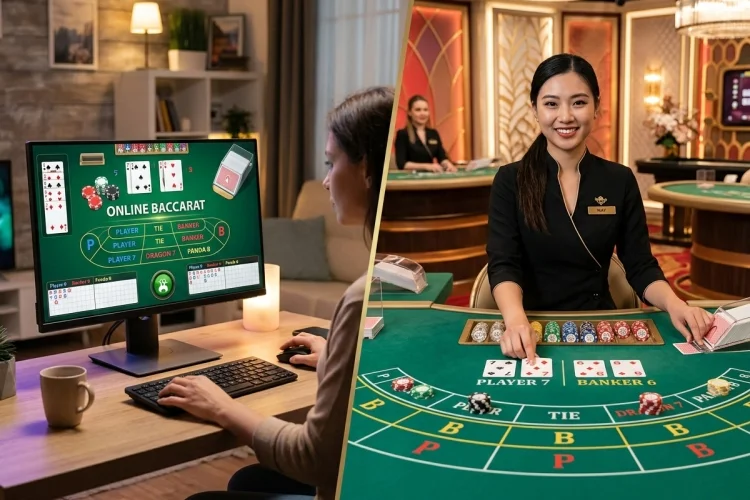
Baccarat is one of the easiest casino table games to understand, but playing it online now comes in two noticeably different formats.

You can choose a digital game where software generates each round or join a live table where a real dealer handles the cards on camera.

Comparing Online Baccarat vs Live Dealer Baccarat is therefore less about learning different core rules and more about understanding how each version delivers the game.

Speed, result generation, social interaction, table availability, and internet requirements can all change the experience, even when the familiar Player, Banker, and Tie bets remain available.

How Standard Online Baccarat Works

Standard online baccarat is generally a software-based casino game.

Instead of watching a real dealer draw cards, a Random Number Generator, or RNG, determines the game’s outcomes. The software then displays those cards through digital graphics or a realistic 3D interface.

Evolution’s First Person Baccarat is one example. It is explicitly described as an RNG baccarat product and offers 12 digital tables, including standard and No Commission versions. Players control the game rather than waiting for a shared live round.

The UK Gambling Commission requires RNG outcomes under its standards to be acceptably random and demonstrably unpredictable using recognised testing methods.

So the main point is simple: there is no live dealer hidden behind the animation. The game result comes from software.

How Live Dealer Baccarat Works

Live baccarat takes the opposite approach.

A real dealer works from a physical casino-style table inside a studio. Cameras broadcast the cards and dealing process while players place wagers through an online betting interface.

Evolution’s live baccarat range includes conventional tables, Speed Baccarat, No Commission Baccarat, and various specialised versions. A normal round in its standard format typically takes around 48 seconds.

Regulated live studios can also face requirements covering trained dealers, commercial-quality equipment, surveillance, secure access, supervision, and game logs. The UK Gambling Commission specifically requires applicable live dealer operations to be fair and independently auditable.

That creates an experience much closer to watching a real casino table.

RNG Baccarat Gives You More Control Over Speed

One of the biggest practical differences is pace.

Online RNG baccarat does not need to wait for other players or a dealer. Once a round finishes, you can normally start another whenever you are ready.

Evolution’s First Person Baccarat even lets users shuffle the shoe, select different tables, and deal free hands to build road histories.

Live baccarat moves according to the studio.

The dealer has to open betting, close wagers, deal the cards, complete any required third-card procedure, announce the result, and prepare the next round.

There are faster live alternatives. Evolution’s Speed Baccarat reduces its typical round from around 48 seconds to approximately 27 seconds by dealing cards face-up and shortening result time.

Faster is not automatically better. More rounds per hour can also mean more opportunities to wager.

The Basic Bets Are Usually Familiar in Both Formats

The core baccarat structure usually remains recognizable.

You generally wager on Player, Banker, or Tie, then the rules determine whether additional cards are drawn. Players do not normally decide whether the Player or Banker hand takes another card.

This makes baccarat different from blackjack, where players repeatedly make hit-or-stand decisions.

Both digital and live formats can also include No Commission variations.

Evolution’s live No Commission Baccarat removes the usual 5% commission from ordinary Banker wins, but when Banker wins with a total of six, the payout becomes 0.5:1.

Its First Person Baccarat similarly includes standard and No Commission RNG tables.

Always check the paytable instead of assuming every baccarat table settles Banker bets identically.

Live Baccarat Has More Human Interaction

Online baccarat is usually a private interaction with software.

There is no dealer speaking to the table, and there is less of the waiting and presentation found in a casino environment.

Live baccarat adds that human element.

You can watch the dealer handle the cards, follow table procedures, and usually see road maps or historical results while the round is happening.

Pragmatic Play’s live baccarat, for example, includes traditional baccarat roads, card zoom functionality, multiple side bets, and both desktop and mobile support.

For players who enjoy casino atmosphere, this can make live baccarat feel more engaging.

For someone who prefers a quiet and quick experiance, the digital version may feel simpler.

Side Bets Can Differ Significantly

Side bets are an area where two baccarat games can become very different.

Live tables may include wagers such as Player Pair, Banker Pair, Perfect Pair, bonuses, or product-specific alternatives.

Evolution’s Ezugi live Baccarat includes optional wagers such as Perfect Pair, Either Pair, Player Pair, and Banker Pair.

Pragmatic Play also highlights multiple optional side bets across its live baccarat product.

RNG games can have equally unusual additions. First Person Lightning Baccarat, for instance, introduces randomly selected Lightning Cards with payout multipliers.

The important lesson is to treat each optional wager seperately.

A large multiplier or headline payout does not automatically mean the side bet has better mathematical value.

Live Baccarat Requires More Streaming Data

A digital baccarat game mostly needs to load graphics and communicate game data.

Live baccarat also has to deliver continuous video.

This makes connection quality more noticeable. Buffering or poor bandwidth can reduce video quality or create a delay between what happens inside the studio and what appears on your device.

The betting system itself still records the official state of the round.

Professional live platforms are designed to synchronize the stream with betting windows, but the player’s connection can affect how smoothly the presentation appears.

Online RNG baccarat is usually less demanding because there is no continuous HD dealer broadcast.

That can make it more convienent on mobile networks or slower connections.

Table Choice Can Be Broader in Live Baccarat

Live casino lobbies often contain several tables aimed at different playing styles.

You may find normal-speed tables, speed tables, VIP-style environments, No Commission Baccarat, regional tables, and games with additional mechanics.

Evolution’s live portfolio, for example, includes Speed Baccarat, No Commission Baccarat, Insurance Baccarat, and several multiplier-based versions.

RNG baccarat can also offer multiple variants without requiring physical studio space.

First Person Baccarat provides 12 tables from one digital lobby, while related RNG products add multipliers and other features.

So table variety exists in both formats; it simply comes from different production systems.

Previous Results Still Do Not Predict the Next Round

Both formats often show baccarat roads and historical results.

These can help players see what happened previously, but patterns should not be treated as a guaranteed forecast.

An RNG game is specifically required under applicable standards to generate unpredictable random outcomes.

A live shoe also does not guarantee that Banker must win simply because Player has appeared repeatedly.

Roads are records, not promises.

Using them as entertainment or visual history is very different from assuming a visible streak makes the opposite outcome “due.”

Which Format Is More Practical?

Online baccarat is generally better suited to players who value self-paced rounds, quick loading, and less dependence on video quality.

Live dealer baccarat focuses more on presentation, dealer interaction, and the feeling of watching a physical casino game.

Neither production format automatically creates better odds.

The more relevant details are the paytable, commission structure, side bets, fees, table limits, and rules of the specific game.

That makes comparing actual tables more usefull than simply choosing “RNG” or “live” as a category.

Online Baccarat vs Live Dealer Baccarat mainly comes down to software-driven convenience versus real-time casino presentation. RNG baccarat offers faster, self-paced play, while live baccarat adds real dealers, cameras, and a shared table atmosphere.

Before playing either format, check the Banker payout rules, side bets, game speed, and table limits so you understand the exact version you are joining.

Table Games

How Roulette Payouts Work: A Simple Guide to Every Standard Bet

Roulette looks simple: place a chip, watch the wheel spin, and hope the ball lands somewhere your wager covers. The confusing part often begins when the table starts showing payout ratios such as 35:1, 17:1, 8:1, or 2:1.

Understanding How Roulette Payouts Work makes those numbers much easier to read. The basic principle is straightforward: bets covering fewer numbers usually offer larger payouts, while bets covering larger sections of the wheel pay less.

However, payout size alone does not tell you whether a wager has better mathematical value.

What Does a Roulette Payout Ratio Mean?

Roulette payouts are generally shown on a “to one” basis.

A payout of 5:1 means you receive five units of profit for every one unit wagered when the bet wins. Your original stake is normally returned separately.

For example, imagine placing $10 on a bet paying 5:1.

A winning result produces $50 in profit, plus your original $10 stake. The total amount returned is therefore $60.

This distinction is important because payout and total return are not identical.

Wizard of Odds lists traditional roulette winnings using this “to one” system and notes that some electronic games may instead display “for one” values, where the original stake is already included.

Straight-Up Bets Pay 35:1

A straight-up wager covers one individual number.

You place the chip directly on a number such as 17, and the ball must land on exactly 17 for the wager to win.

Traditional roulette pays 35:1 for this result.

Suppose you wager $5:

$5 × 35 = $175 profit.

After adding the original $5 wager, your total return becomes $180.

The large payout exists because the wager covers only one pocket. On a European wheel there are 37 possible pockets, while American roulette has 38 because it adds 00.

A 35:1 payout may look attractive, but the winning probablity is correspondingly low.

Split Bets Cover Two Numbers

A split bet covers two neighboring numbers on the betting layout.

For example, placing a chip on the line between 14 and 17 means either number can produce a win.

The traditional payout is 17:1.

A $5 winning split therefore produces:

$5 × 17 = $85 profit.

Add the original wager and the total return becomes $90.

Compared with a straight-up bet, your coverage doubles, but the payout falls from 35:1 to 17:1.

That relationship continues as more numbers are included in a wager.

Street, Corner, and Six-Line Bets

A street covers three numbers in one horizontal row and traditionally pays 11:1.

A $5 winning street generates $55 in profit plus the $5 original stake.

A corner covers four adjacent numbers and pays 8:1. The same $5 wager produces $40 profit and $45 returned in total.

A six-line wager covers two adjacent streets, meaning six numbers are included. The payout is 5:1.

With $5 at risk, a successful six-line wager generates $25 in profit plus the returned stake.

This progression demonstrates the basic roulette payout structure: increasing coverage generally reduces the amount paid for each winning unit.

Dozen and Column Bets Pay 2:1

Dozens and columns each cover 12 of the numbered spaces from 1 through 36.

The three dozen wagers are:

1–12, 13–24, and 25–36.

The three columns divide those same 36 numbers vertically across the betting layout.

Both bet types traditionally pay 2:1.

If you place $10 on the first dozen and a number from 1 through 12 wins, you earn $20 profit. Your original $10 is also returned, producing $30 total.

Zero and double zero are not included in normal dozen or column bets.

That detail is one reason the casino retains an advantage even though covering 12 numbers may initially seem fairly generous.

Even-Money Bets Pay 1:1

Red or black, odd or even, and low or high are usually called outside or even-money bets.

They pay 1:1.

A $20 winning red wager therefore earns $20 profit and returns the original $20 stake, leaving $40 in total.

These wagers cover 18 numbers, but they are not truly 50/50 bets because zero – and 00 on an American wheel – does not belong to either side.

On a single-zero wheel, the chance of winning a conventional even-money bet is 18 out of 37, or about 48.65%. On a standard double-zero wheel, it falls to 18 out of 38, or about 47.37%. Wizard of Odds calculates the standard house edges at approximately 2.70% and 5.26% respectively.

That small green pocket makes a major mathematical difference.

Why Bigger Payouts Do Not Mean Better Value

It is easy to look at 35:1 and assume straight-up bets are more rewarding than 1:1 red or black wagers.

The missing piece is probability.

A single-number wager pays much more precisely because it wins much less frequently.

On standard European roulette, most conventional bets share the same 2.70% house edge even though their payouts and hit frequencies are dramatically different. Standard American roulette similarly gives most common wagers a 5.26% house edge.

So choosing between red and a single number mainly changes variance and win frequency rather than eliminating the mathematical casino advantage.

The payout schedule is designed around the number of outcomes covered.

European and American Payouts Are Usually the Same

One surprising point is that European and American roulette generally use the same standard payout ratios.

A straight-up number still pays 35:1. A split still pays 17:1. Red or black still pays 1:1.

What changes is the wheel.

European roulette has numbers 1–36 plus one zero, producing 37 pockets. American roulette adds 00 for 38 total pockets. Evolution confirms these layouts for its European and American live roulette products.

Because American roulette has an additional losing green result without increasing the standard payouts, the house advantage rises.

The payout printed on the table can therefore stay identical while the underlying mathematical value changes.

The American Five-Number Bet Is Different

American roulette also offers a distinctive five-number wager covering 0, 00, 1, 2, and 3.

This wager traditionally pays 6:1.

According to Wizard of Odds, its house edge is about 7.89%, compared with roughly 5.26% for most other conventional wagers on a double-zero wheel.

That makes it a useful reminder that not every roulette wager on the same wheel necessarily has identical mathematical value.

Players should check both the payout and the numbers covered rather than assuming all bets are structured equally.

Check the Table Before Assuming Standard Payouts

Standard roulette has familiar payout ratios, but modern variants can modify them.

Electronic roulette, multiplier games, or branded live tables may use special rules.

Evolution’s Lightning Roulette, for example, reduces the ordinary non-multiplied straight-up payout to 29:1 while offering randomly selected numbers with much larger multiplier possibilities. Other standard wagers continue paying according to conventional roulette rules.

Modern Pragmatic Play roulette variants can similarly add Lucky Numbers or multiplier mechanics on top of European roulette gameplay.

That means the traditional paytable is a starting point, not something to assume applies to every product.

Always read the actual game information.

Learning How Roulette Payouts Work comes down to understanding coverage and payout ratios. Straight-up wagers pay 35:1, while broader bets such as dozens, columns, and even-money options offer smaller payouts but cover more numbers.

Before wagering, check the wheel type and actual paytable, especially on modern multiplier variants, so you know exactly how each winning result will be calculated.

Table Games

When to Hit, Stand, Split, or Double Down in Blackjack

Blackjack looks simple until the dealer gives you two cards and suddenly asks for a decision. Should you take another card, stay where you are, divide a pair, or double your original bet? Each choice can change the mathematical value of the hand.

Learning When to Hit, Stand, Split, or Double Down is the foundation of blackjack basic strategy. The goal is not to predict the next card or guarantee a win.

Instead, basic strategy chooses the action with the best mathematical expectation – or the smallest expected loss – under a specific set of table rules.

First, Understand What Each Action Means

Before thinking about strategy, understand exactly what the four main actions do.

Hit means taking another card. You can normally continue hitting until you stand, reach 21, or go above 21 and bust.

Stand means keeping your current total and ending your decisions for that hand.

Double down normally requires an additional wager equal to your original stake. You then receive exactly one more card and must stand. Split is available when the first two cards form an eligible pair; you add another wager and turn those cards into two hands.

Exact splitting and doubling restrictions vary by casino, which is why the table rules should always be checked first.

When Should You Hit?

Hitting is usually appropriate when your total is too weak to stand safely against the dealer’s visible card.

For hard hands, very low totals are straightforward. With hard 8 or lower, taking another card cannot immediately bust the hand.

Decisions become more interesting around hard 12 through 16.

Under common multi-deck basic strategy, a player often stands with hard 13–16 when the dealer shows 2–6, but hits those totals against stronger dealer cards such as 7 through Ace. Hard 12 is more specific: it is commonly hit against 2 or 3 and stood against 4–6.

The reasoning is not that a dealer 4–6 is guaranteed to bust. Those upcards simply create circumstances where standing can have better expected value than risking another card.

When Should You Stand?

Standing becomes obvious once the hand reaches a strong hard total.

Hard 17 or above is generally a stand under conventional blackjack rules. Taking another card would create too much bust risk without enough potential improvement.

The less obvious stands happen with weaker totals against vulnerable dealer upcards.

For example, standing on hard 14 against a dealer 5 might feel conservative. However, basic strategy considers the dealer’s required drawing rules and the probabilities of all possible outcomes rather than simply asking whether 14 is a “good” hand.

That distinction is extreemly important.

Basic strategy does not ask, “Do I like my total?” It asks, “Which legal action has the best expected result against this particular dealer upcard?”

When Does Double Down Make Sense?

Doubling increases both your wager and your exposure, so it should only be used when the starting hand has sufficiently favourable mathematical conditions.

Hard 10 and 11 are the classic examples.

Under many common multi-deck rules, hard 10 is doubled against dealer 2–9, while hard 11 is frequently doubled against dealer 2–10. Exact recommendations can change with deck count, dealer soft-17 rules, and whether the dealer checks for blackjack.

Hard 9 can also be doubled in certain situations, commonly against weaker dealer cards such as 3–6.

Why?

A large proportion of remaining cards improve 9, 10, or 11 into strong totals. Doubling lets you increase the wager when the situation is mathematically more favourable – but you give up the right to draw a second additional card.

That trade-off is the entire point.

When Should You Split a Pair?

Splitting transforms one hand into two, which means the decision should depend on more than whether two cards happen to match.

Two pairs stand out immediately: Aces and eights.

A pair of aces totals either 2 or 12, neither of which is particularly useful as one hand. Splitting creates two opportunities to begin with an Ace.

Two eights produce hard 16, one of blackjack’s most difficult totals. Splitting can improve the expected result even though doing so requires an additional bet.

Wizard of Odds calculations illustrate that splitting eights can have a better expected value than hitting, standing, or doubling in applicable situations.

By contrast, tens are generally kept together. A pair of tens is already hard 20, one of the strongest possible hands. Pagat similarly notes that splitting tens is almost always poor conventional play.

What About Fives and Nines?

Pairs can be deceptive because their combined hard total sometimes matters more than their matching ranks.

A pair of fives equals hard 10.

Instead of splitting a strong starting total into two weak five-point hands, basic strategy normally treats the hand as a 10 and may double against appropriate dealer cards.

Wizard of Odds strategy charts specifically treat pairs of fives through the hard-total strategy rather than recommending a normal split.

Nines are more situational.

They are commonly split against several dealer upcards but stood against others. This is why memorizing “always split pairs” is a bad shortcut.

Pair strategy depends heavily on what the dealer is showing.

Soft Hands Need Different Decisions

A soft hand contains an Ace that can still count as 11 without making the hand bust.

For example, Ace-6 is soft 17.

That hand is fundamentally different from hard 17 because drawing another card cannot immediately bust it. If you draw a 10, the Ace simply changes from 11 to 1, leaving a total of 17.

This flexibility creates additional hitting and doubling opportunities.

Soft 18 is a classic example. Depending on the dealer upcard and table rules, basic strategy may recommend standing, hitting, or doubling. Wizard of Odds specifically notes that soft-hand recommendations depend on dealer cards and whether doubling is available.

Treating every 17 or 18 identically is therefore a common beginer mistake.

Why the Dealer’s Upcard Matters So Much

Your own cards are only half of the decision.

A dealer showing 5 is in a very different position from a dealer showing 10.

Dealers typically have fixed drawing rules, which means they cannot adjust strategy the way players can. Their visible card therefore gives useful information about the range of possible final totals.

Basic strategy uses that information mathematically.

This is why hard 16 may be stood against a dealer 6 yet hit against a dealer 9. The player’s hand has not changed, but the relative strength of the dealer’s position has.

Thinking in terms of your hand plus the dealer upcard is much more accurate than memorizing actions based on your own total alone.

Table Rules Can Change the Correct Decision

There is no single blackjack chart that applies perfectly to every table.

The number of decks matters. So does whether the dealer hits or stands on soft 17, whether doubling after a split is allowed, whether surrender exists, and whether blackjack pays 3:2 or 6:5.

Wizard of Odds provides different strategy charts and calculators specifically because these rule variations can alter the mathematically preferred action.

The UK Gambling Commission likewise notes that blackjack has an inherent house advantage and requires licensed casino environments under its rules to make game rules and house-edge information available.

So check the table before using a memorized chart.

Basic Strategy Reduces Mistakes, Not Risk

Basic strategy cannot tell you which card is coming next.

It simply chooses the action with the strongest mathematical expectation based on known information and the table’s rules.

Wizard of Odds gives an example where a simplified strategy produces a higher house edge than full correct basic strategy under the same six-deck conditions.

That demonstrates why consistent decisions matter over many hands.

It does not mean losses disappear.

Blackjack remains gambling, and shorter sessions can vary substantially from mathematical averages. Set a money limit rather than increasing stakes to recover previous losses; safer-gambling guidance also recommends setting both spending and time limits.

Knowing When to Hit, Stand, Split, or Double Down is about comparing your hand with the dealer’s upcard and following the correct strategy for that table’s rules.

Learn hard totals, soft hands, and pair decisions separately instead of guessing. Before playing, check the number of decks and dealer rules, then use the appropriate basic-strategy chart as your reference.

Live Casino

Live Dealer Casino Games: A Complete Beginner’s Guide

Online casino games do not always rely on animated cards, digital wheels, or computer-generated tables. Live casino technology allows players to watch real dealers handle cards, spin roulette wheels, and manage games through a real-time video stream.

Live Dealer Casino Games combine parts of a traditional casino floor with the convenience of online play. You interact through a digital betting interface while a dealer conducts the physical game in a studio.

For beginners, understanding the streaming process, table rules, betting windows, game variations, and limits makes the experience much easier to follow.

What Are Live Dealer Casino Games?

Live dealer games are online casino games conducted by real dealers or presenters and streamed to players over the internet.

Instead of watching an animated roulette wheel, for example, you may see a physical wheel being spun in a professional studio. In blackjack, a dealer can handle real cards while players make decisions through buttons on their screens.

Evolution describes its live casino studios as advanced broadcasting environments using cameras, audio equipment, and IT systems to transmit games in real time. Players can place bets, make game decisions, and interact through the interface.

The basic idea is simple: physical casino action happens in one location while the player participates remotely.

How a Live Dealer Studio Works

A professional live casino studio looks partly like a casino and partly like a television production set.

There may be multiple tables operating at the same time, each with dealers, cameras, lighting systems, microphones, and game-monitoring equipment. Some providers also operate branded or dedicated studios for particular casino operators.

Multiple cameras help viewers see the important parts of each round. Roulette may show the dealer and wheel from different angles, while baccarat can use close-up shots of the cards.

Evolution’s Live Baccarat Squeeze, for example, uses numerous cameras to capture the card-reveal process from several angles.

Behind the visible studio is software connecting the physical game with the online betting interface.

What Happens When You Join a Table?

Joining a table normally does not interrupt the current game.

You may enter while a round is already underway and wait until the next betting period begins. Once betting opens, the screen displays virtual chips or controls that let you select an available wager.

A countdown usually shows how much time remains.

When betting closes, the dealer performs the next action, such as dealing cards or spinning the roulette wheel. Results are then reflected in the online interface before the next round begins.

This repeated cycle makes live games relatively easy to understand after watching a few rounds.

Many interfaces also include game history, statistics, rules, and chat functions, although exact features vary by provider and jurisdiction.

Popular Types of Live Casino Games

Several traditional casino games have become standard live dealer categories.

Live Blackjack

Blackjack lets players make decisions such as hit, stand, double, or split where the rules permit. Live versions may include standard tables, speed formats, unlimited-seat variants, and additional side bets.

Evolution currently offers multiple live blackjack formats, including conventional and alternative versions designed for desktop and mobile play.

Live Roulette

Live roulette uses a physical or automated wheel while bets are placed digitally.

Players can usually choose from familiar inside and outside wagers, although exact payouts and wheel formats depend on the table. Evolution also offers speed, VIP, immersive, and other roulette variants.

Live Baccarat

Baccarat generally asks players to wager on Player, Banker, or Tie.

Some tables include additional options such as pairs and other side bets. Evolution’s baccarat portfolio illustrates how one basic game can be offered in standard, speed, squeeze, and no-commission formats.

How the Dealer and Software Work Together

The dealer handles the physical part of the game, while software manages the player’s digital interation.

A blackjack dealer may physically draw cards while the software displays your available decisions. At a roulette table, the result of the physical wheel is communicated to the game interface so qualifying bets can be settled.

Players should remember that not every product using realistic video is necessarily a live-dealer game.

Evolution’s EZ Dealer Roulette, for example, uses pre-recorded video together with an RNG rather than a live dealer conducting each round in real time.

Checking the game’s information screen helps distinguish genuine live tables from RNG or hybrid products.

Why Table Limits Matter

Live tables can have very different minimum and maximum stakes.

A lower-limit blackjack or roulette table may suit someone working with a smaller entertainment budget, while VIP tables can require much higher stakes. Evolution specifically offers multiple table types with varying limits, including higher-limit VIP environments.

Always check the minimum wager before joining.

A $100 budget behaves very differently at a $1 table than at a $20-minimum table. The second table allows far fewer rounds if results go against you.

Table limits therefore matter more for bankroll planning than the appearance of the studio.

Understand Side Bets Before Using Them

Live blackjack and baccarat tables often provide optional side bets alongside the main game.

For example, baccarat may offer wagers based on pairs or other special card combinations. Ezugi’s standard Baccarat lists side bets such as Perfect Pair, Either Pair, Player Pair, and Banker Pair.

These wagers can make a round more varied, but their rules and payouts should be evaluated seperately from the main bet.

A visually large payout does not automatically indicate better mathematical value.

Open the help menu and check what outcome is required, what the payout is, and whether the wager carries different odds from the standard game.

What Are Live Casino Game Shows?

Live casino content now extends beyond traditional blackjack, roulette, and baccarat.

Game-show products combine live presenters with large wheels, multipliers, bonus rounds, or other interactive-style features. Evolution lists titles such as Crazy Time, MONOPOLY Live, Dream Catcher, and other live game-show formats.

These games may look closer to television entertainment than a traditional casino table.

However, the same basic rule applies: understand how each bet is settled before wagering.

Multipliers and bonus rounds may look dramatic, but the paytable and probability structure remain more important than the presentation.

Check Licensing Before Playing

A polished live stream does not prove that the casino operating the website is properly regulated.

Licensing depends on jurisdiction. In Great Britain, companies offering online gambling to consumers must hold the appropriate Gambling Commission licence, and consumers can check the regulator’s public register.

Other countries use different licensing frameworks.

Before depositing, verify which legal entity operates the website, which regulator oversees it, and whether the casino is authorised for your location.

Do not rely only on a licence logo shown in a footer.

Keep Live Play Within a Clear Budget

Live games can move quickly.

Evolution’s Speed Roulette, for example, advertises rounds that can complete in around 25 seconds.

Faster rounds mean more wagering opportunities can occur within the same amount of time.

That makes stake size and session limits particularly relevent. Decide what amount is available for entertainment before joining the table, rather than increasing the budget after losses.

Where responsible gambling tools are availble, financial limits can provide another boundary around spending.

Live Dealer Casino Games combine real dealers, physical equipment, streaming technology, and online betting interfaces in one experience. Blackjack, roulette, baccarat, and live game shows can all use slightly different rules and limits.

Before joining a table, check its betting range, paytable, game format, licensing information, and optional wagers. Most importantly, decide your entertainment budget before the first round begins.

Online Slots

How Cascading Reels Work in Online Slots: A Simple Guide

Cascading reels have become one of the most recognizable mechanics in modern online slots.

Instead of finishing immediately after a winning combination appears, certain symbols disappear and new ones drop into the empty spaces, potentially creating another win without starting a completely new paid spin.

Understanding How Cascading Reels Work makes these games much easier to follow. The mechanic may also be called tumbling reels or Avalanche-style gameplay depending on the developer.

Although the animation can look complicated, the basic idea is surprisingly simple once you break the sequence into stages.

What Are Cascading Reels?

Cascading reels are a slot mechanic where symbols involved in a winning combination are removed from the grid. New symbols then enter the available spaces.

If those replacements create another qualifying combination, another cascade happens. This process can continue repeatedly until the new symbols no longer produce a win.

Pragmatic Play’s Jewel Rush, for example, removes winning symbols and replaces them with new ones, continuing the process until no additional matching combination remains.

Different studios use different names for essentially similiar ideas. Pragmatic Play frequently calls the mechanic a Tumble, while NetEnt’s Gonzo’s Quest uses its trademarked Avalanche mechanic.

How a Cascade Starts

A cascade normally begins after the initial reel or grid result forms a qualifying win.

Imagine a fictional six-reel slot where eight matching gem symbols are required. You press spin, eight blue gems appear, and the combination qualifies for a prize.

Rather than resetting the entire grid, those eight gems disappear.

The remaining symbols stay where they are while replacements fall into the empty positions. Depending on the game’s design, symbols may drop vertically, appear from above, or refill the grid using another animation.

Sweet Bonanza uses this basic approach: winning combinations disappear and replacement symbols tumble down from above.

The important detail is that the cascade belongs to the ongoing game sequence rather than requiring the player to manually trigger another standard spin.

What Happens During a Second Cascade?

Once new symbols arrive, the game evaluates the updated grid again.

Suppose those replacement symbols form another winning combination. The second group disappears and another set drops in.

You might therefore see a sequence like:

Initial result → Win → Cascade → Win → Cascade → No Win.

When the grid no longer produces the combination required by the game’s rules, that sequence finishes.

The number of cascades is not necessarily fixed. A sequence might stop after the first replacement or continue through multiple consecutive wins.

This makes cascading games feel more active because one paid action can produce several visual stages.

Cascades Can Use Different Win Systems

Not every cascading slot uses traditional paylines.

Some games require matching symbols anywhere on the grid. Others use cluster pays, ways-to-win systems, adjacent symbols, or conventional reel patterns.

Sweet Bonanza, for instance, awards prizes when enough matching symbols appear anywhere on its tumbling grid.

Jewel Rush takes another approach, using a 7×7 board where groups of matching symbols can produce wins before the symbols are removed.

Meanwhile, Gonzo’s Quest uses paylines alongside its Avalanche mechanic. When a winning combination occurs, the winning icons explode and replacements cascade downward.

This is why players should always open the paytable. The presence of cascading reels does not tell you how a qualifying win is actually calculated.

How Multipliers Can Change During Cascades

Multipliers are often paired with cascading mechanics because they can increase the value of later wins within a sequence.

One of the clearest examples comes from Gonzo’s Quest. Evolution explains that each Avalanche action increases the win multiplier by one level, potentially reaching 5x.

This means consecutive Avalanche wins can become more valuable as the sequence develops.

However, that is not a universal rule.

Another slot may introduce multiplier symbols only during free spins, while another might add several multipliers together. Some games reset the multiplier after every complete sequence.

Never assume that every cascading slot rewards consecutive wins in the same way. The exact multiplier rules are part of each game’s individual design.

Cascading Reels and Bonus Features

Cascades frequently interact with free spins, scatter symbols, expanding reels, or progressive multipliers.

Pragmatic Play’s Pompeii Megareels Megaways, for example, combines its tumble mechanic with expanding reels. Winning combinations trigger new symbols while reels involved in winning combinations can expand, changing the number of available ways to win.

Sweet Bonanza takes a different approach. During its bonus feature, multiplier symbols can appear while tumble sequences are taking place, with qualifying multiplier values combined at the end of the sequence.

This combination of features can make bonus rounds appear much more complex than the base game.

The easiest approach is to seperate each rule: first understand what creates a normal win, then what causes a cascade, and finally how bonus modifiers affect those wins.

Do Cascading Reels Improve Your Odds?

The mechanic itself should not be treated as proof that a slot is mathematically better than a non-cascading game.

A game’s overall mathematics depend on factors including symbol probabilities, paytable values, bonus frequency, volatility, maximum payouts, and theoretical return.

A slot can offer many cascades while still being highly volatile. Another might produce fewer dramatic sequences but distribute prizes differently.

The UK’s Gambling Commission explains the broader RTP concept as a long-term average achieved over a large number of games, rather than the amount someone should expect during a single session.

So an entertaining cascade animation does not guarantee a particular return.

Can One Cascade Predict the Next?

Seeing several consecutive winning drops can make it feel as though the game has entered a “hot” period.

That is not a reliable prediction strategy.

For random gaming machines, UK Gambling Commission guidance states that the chance of winning the current game is not changed by wins or losses in previous games.

The same basic caution is useful when looking at cascade patterns. A long previous chain does not mean another long chain is automatically coming.

Likewise, many short sequences do not prove that a large cascade is “due.”

Animations can make patterns feel meaningfull even when earlier results provide no reliable forecast of the next outcome.

What Beginners Should Check Before Playing

Start with the game’s information screen rather than relying on the visual presentation.

Find out how many symbols are needed for a win, whether combinations use paylines or clusters, what happens to winning symbols, and when the tumble sequence ends.

Then check multiplier rules and free-spin conditions.

You should also look at the minimum bet, theoretical RTP where provided, volatility information, and maximum payout conditions.

Cascading mechanics become much easier to understand when you know exactly what causes each stage of the sequence.

Understanding How Cascading Reels Work is mainly about following a simple cycle: winning symbols disappear, replacements arrive, and the updated grid is checked again.

Multipliers and bonuses can make that cycle more complex, but the core mechanic stays straightforward. Before playing a cascading slot, open its paytable and learn its specific tumble rules instead of assuming every game works identically.

View More