
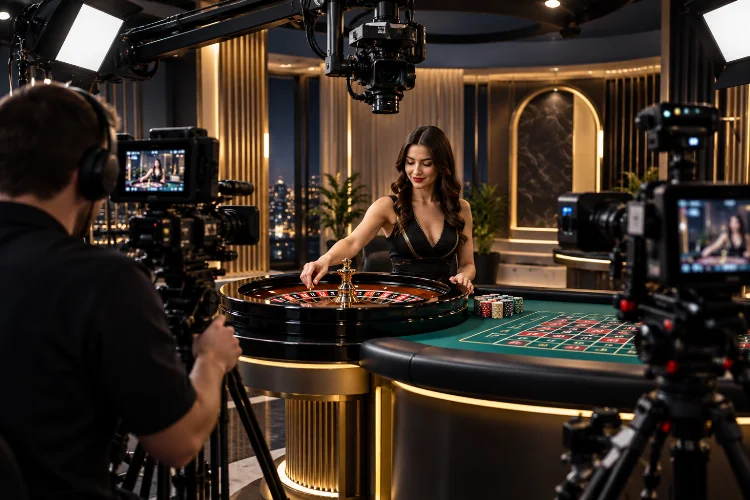
Multiple-Camera Streaming: How It Improves Live Casino Games
A live casino would feel very different if the entire game were filmed by one static webcam. You might see the dealer clearly but miss the cards, or get a perfect view of a roulette wheel while barely seeing anything else happening at the table.
That is why Multiple-Camera Streaming has become an important part of modern live casino production.
By combining wide views, close-ups, overhead shots, and carefully timed camera changes, providers can make games easier to follow while creating an experience that feels much closer to a professionally produced television broadcast.
Why One Camera Is Usually Not Enough
A live casino table contains several points of interest at the same time.
There is the dealer, the cards or wheel, the betting area, and often additional physical equipment. A single wide camera could technically show all of them, but important details would become very small on a phone or laptop.
Multiple cameras solve that problem by dividing the visual workload.
One angle can frame the dealer and whole table. Another can concentrate on the cards, while a dedicated roulette camera can focus on the ball and wheel.
Evolution’s Immersive Roulette provides a clear example. The game uses multiple cameras to bring viewers closer to the wheel and follows the movement of the ball using high-frame-rate HD video.
The result is better visibilty without forcing the viewer to stare at one distant image throughout the entire round.
Different Camera Angles Have Different Jobs
Multiple-camera production works best when each angle has a specific purpose.
The wide shot establishes the overall scene. It lets viewers see the dealer, table, and physical surroundings together.
Close-up cameras handle smaller details.
During blackjack or baccarat, the production can focus closely on cards when they are revealed. Roulette can use tighter views around the wheel, while game-show products may switch between the presenter, physical game equipment, and wider studio shots.
Pragmatic Play’s Mega Wheel, for example, is broadcast from a purpose-built studio in HD and uses multiple camera angles as part of its live presentation.
This resembles television production more than ordinary video calling.
The goal is not simply to install many cameras. Each view needs to show something useful at the moment the viewer actually needs to see it.
Camera Switching Makes the Game Easier to Follow
The real advantage appears when those camera feeds are combined intelligently.
Imagine a roulette round.
During betting, viewers may see the dealer and complete table. Once the wheel starts moving, the production can move closer to the roulette wheel. When the ball settles, another view can highlight the result.
The player does not need to manually select every angle.
Behind the scenes, a production system can mix several camera feeds into one stream. Vivo Gaming describes its production pipeline as combining multi-camera HD capture with live-view mixing before the final output is streamed to users.
That switching creates visual continuity.
Done properly, viewers barely notice the technical process. They simply receive a clearer view of whatever part of the game currently matters.
Poor switching would have the opposite effect, making the experiance distracting rather than immersive.
Close-Ups Can Improve Result Visibility
Live casino players are watching real physical events through a screen, so being able to see those events clearly matters.
When a blackjack dealer reveals a card, a close-up can make the rank and suit easier to identify.
In roulette, a tight wheel shot gives viewers a better look at the ball as it slows and reaches a numbered pocket.
Pragmatic Play’s Crystal Roulette demonstrates this visual approach. The provider describes exclusive camera angles and high-definition close-ups designed to showcase its transparent roulette wheel and game action.
This does not mean camera coverage determines whether a game is fair.
Fairness depends on operating procedures, rules, equipment, oversight, and regulation.
However, good visual coverage can make the physical process more understandable to the viewer because fewer important moments happen far away from the camera.
Multiple Cameras Support Replays and Cinematic Presentation
Some live games go beyond simple angle switching.
Evolution’s Immersive Roulette combines its multi-camera production with slow-motion replay of the winning result, while using video captured at up to 200 frames per second for the wheel sequence.
This type of feature would be difficult to achieve convincingly using one basic fixed camera.
Multiple feeds give producers more material to work with.
The same principle has been used in baccarat. Evolution has previously offered Multi-Camera Live Baccarat configurations where operators could select camera numbers, shot angles, and sequences to create different presentation styles.
The benefit is partly practical and partly cinematic.
Players can see important details more clearly, while the broadcast gains movement and visual variety instead of showing the same frame for every round.
Camera Synchronization Matters as Much as Camera Quality
Installing several expensive cameras does not automatically create a good stream.
The feeds also need to remain syncronized with one another and with the digital game state.
Vivo Gaming describes a production process where metadata and timestamps connect video footage, game state, and results before the content is delivered through its streaming system.
That coordination is important.
Suppose the interface declares a winning result before the relevant camera angle visibly shows it. Even a short mismatch could make the experience feel confusing.
Similarly, an awkward delay between camera switching and physical action can break immersion.
Modern live casino production therefore combines camera equipment with software, timing data, network infrastructure, and control-room systems.
The cameras may be the most visible part, but they are only one component of the broadcast.
Multiple Views Can Work Especially Well on Mobile
Smaller screens make detailed camera work even more useful.
A desktop monitor can display a wide table shot without making everything tiny. A smartphone has much less space.
Close-ups help compensate for that limitation.
Instead of expecting a mobile user to identify a card from a large studio-wide view, the production can switch directly to the relevent part of the table.
Streaming systems also need to adapt the presentation for different devices.
Vivo’s production pipeline supports video delivery across desktop and mobile, including portrait and landscape HTML5 presentation.
This does not mean every provider uses exactly the same approach.
Some interfaces resize video, others reposition betting controls, and certain games are specifically designed around vertical mobile screens.
The broader principle remains the same: good framing matters more as screens become smaller.
Camera Coverage Also Supports Operational Oversight
There is another side to casino cameras that players may not immediately notice.
Regulated live-dealer studios can be required to maintain video surveillance for operational integrity.
UK Gambling Commission technical standards state that live-dealer operations must be fair and independently auditable. They also call for video surveillance sufficient to review dealer activity and determine whether documented procedures and game rules were followed.
That surveillance is not necessarily identical to the cinematic feed a player sees.
The two systems can serve different purposes.
One is mainly about presenting the game. The other helps support monitoring, auditing, and investigation.
Together, they illustrate why live casino video technology involves much more than simply pointing a webcam at a dealer.
More Cameras Do Not Mean Better Odds
It is important to seperate presentation quality from casino mathematics.
A table with six camera angles does not automatically offer better RTP, a smaller house edge, or a higher probability of winning than a table with three.
Camera technology changes what you can see.
Game rules determine the underlying mathematics.
An immersive roulette production may provide dramatic wheel close-ups and replays, but players should still examine the roulette format, payouts, and rules when assessing the game itself.
In other words, multi-camera production can significantly improve usability and entertainment value without changing the probability behind the next card, wheel result, or other outcome.
Multiple-Camera Streaming improves live casino games by showing the right part of the action at the right moment. Wide shots establish the table, close-ups clarify results, and carefully timed switching makes physical games easier to follow.
When exploring live tables, look at streaming quality and clarity as part of the overall experience – but remember that better cinematography improves presentation, not the underlying odds.