
What Is a Live Dealer Casino and How Does the Technology Work?
A live casino table may appear simple on screen: a dealer stands behind a table, cards are dealt, and players place bets through digital chips.
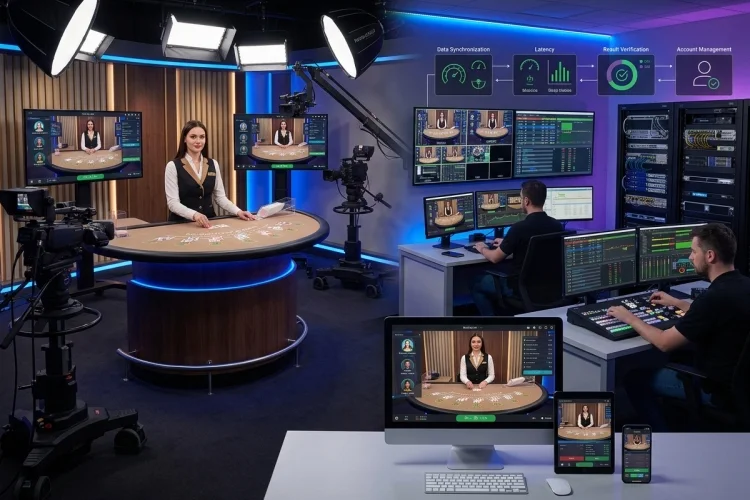
Behind that presentation is a coordinated system involving studio production, physical casino equipment, video streaming, betting software, account management, and result verification.
The objective is to reproduce important parts of a land-based casino experience while allowing players to participate remotely.
A user can join from a desktop computer or mobile device, watch the same physical round as many other participants, and receive an individual payout based on the wager submitted through the interface.
Understanding what a live dealer casino is from a technical perspective explains why timing, synchronization, camera quality, and studio procedures are essential.
Unlike a standard virtual table, the main game outcome is created by physical cards, dice, or wheels.
Software is still necessary, but its role is primarily to manage wagers, display information, communicate decisions, and apply the recorded result to player accounts.
Professional Live Casino Studios
Many live games are broadcast from studios designed specifically for online casino production. These locations may contain multiple tables, cameras, lighting systems, control rooms, dealer areas, and technical support teams.
Dealers work in front of cameras rather than serving players seated physically at the table. Evolution describes its service as combining studios, software integration, technical systems, and trained staff to provide live casino products on computers and mobile devices.
Some games may also be transmitted from actual casino floors. In either format, the environment must support clear visibility, secure procedures, and uninterrupted operations.
Cameras and Real-Time Streaming
Live tables commonly use several camera angles. One may show the dealer, while another provides a close view of cards, a roulette wheel, or other important equipment.
Video is compressed and transmitted to the casino interface through streaming technology. The aim is to provide a clear view without requiring excessive bandwidth or creating a delay that interferes with betting.
Players do not normally control the main broadcast. However, some interfaces allow them to change camera views, adjust quality, mute sound, or expand the game window.
Physical Equipment Determines the Result
Live roulette uses a physical wheel and ball, while live blackjack and baccarat use real cards. These items perform the same basic role as equipment in a land-based casino.
The UK Gambling Commission distinguishes live dealer games from RNG-driven products because physical equipment determines the results. It also notes that integrity controls may cover the manufacture, installation, and continued operation of that equipment.
Automatic card shoes or other devices may assist with game operation, depending on the table. The exact equipment and procedures should match the approved rules.
The Betting Interface Connects Players to the Table
Although the dealer handles physical equipment, wagers are placed electronically. Players choose digital chip values and select positions on the betting layout before the countdown closes.
The system confirms each accepted wager and deducts it from the available balance. UK remote standards require clear information about the amount being gambled, including conversions between currency, credits, chips, or similar tokens.
In decision-based games such as blackjack, the interface displays buttons for actions including hit, stand, double, or split. Only actions allowed by the table rules become available.
Synchronization and Result Processing
A central challenge is matching every digital wager with the correct physical round. The platform must know when betting opens, when it closes, what outcome occurred, and which accounts qualify for payouts.
Live dealer testing performed by GLI includes synchronicity tests alongside technical, staffing, premises, and systems evaluations. This helps assess whether the studio action and digital platform operate together correctly.
Results may be entered or detected through approved operational systems. Once confirmed, the software calculates winnings and updates player balances.
Shared, Dedicated, and Localized Tables
A shared table may be available through several online casino brands. Players from different operators participate in the same physical game while accessing it through separate websites.
Dedicated tables are created for a particular operator and may include customized branding, environments, uniforms, or language options. Evolution describes dedicated live environments that can be designed around an operator’s identity and target markets.
Localized tables may use dealers speaking a specific language or follow rules designed for a regulated market. The underlying game mechanics can remain similar even when the presentation differs.
Testing, Auditing, and Studio Security
Regulated live casino operations must meet the standards of their licensing jurisdiction. The UK Gambling Commission requires live dealer operations to be fair and independently auditable.
Testing may cover equipment, staffing responsibilities, physical premises, technical systems, and synchronization. Operators may also need access controls, recorded footage, incident procedures, and audit trails.
The Commission’s remote technical standards additionally cover security obligations for licensed remote gambling and software operators. These controls support integrity but cannot eliminate the mathematical advantage built into table-game rules.
Connection Quality and Device Performance
A live table depends more heavily on internet quality than a basic automated game. Slow connections may cause lower video resolution, interruptions, or delayed displays.
Players should use a stable network and keep the game visible during decision periods. Closing the browser or losing connectivity may cause the system to apply a default action according to the game rules.
Before betting, test the stream, sound, controls, and countdown. A table with lower video quality may be more usable than a high-definition stream that repeatedly freezes.
A live dealer casino is powered by more than a video feed. Professional studios, physical equipment, trained dealers, cameras, betting interfaces, account systems, and result-processing technology must work together during every round.
Physical cards, wheels, or dice create the main outcomes, while software accepts wagers, communicates player decisions, records results, and calculates payouts.
Independent testing and regulatory audits help confirm that the complete operation functions correctly. Watch a table before joining, test your connection, and read its rules and betting limits.
Select a licensed platform whose live games operate smoothly and transparently, and always establish an affordable entertainment budget before placing a wager.